The Dunning–Kruger effect: how to teach kids to distinguish between a real expert to a pretend one

Meir Nitzan

Not long ago I attended a workshop to upgrade my LinkedIn profile. The speaker’s message was sharp - exaggerate!
“Your profile is like a wedding; you show up to a wedding dressed nicely, hair done, perfume on, right? That’s different from another night on the couch!” he half-shouted at us. “Your profile is a social meeting at a wedding - dress it up.”
It was a fairly fancy workshop meant to make over people lost on social networks (I arrived by accident). One participant asked the speaker innocently: “Umm, if I do some financial consulting on the side, what should I put on my profile?”
“Expert!” the speaker said firmly.
“You’re an expert in financial planning,” he repeated, pleased with the whispers in the room, “expert and speaker!”
He explained there was no reason to hesitate and that it was time we left the movie we’re living in: “It’s not like anyone’s going to give you a test, right?”
It kind of feels like everyone became an expert in something, or a commentator on some topic - and only we small ones aren’t sure we understand anything in the field we work in every day. We have a degree and a half or two, but when people ask our advice we stammer.
Have you ever asked yourselves how our kids relate to expertise?
If we take our financial advisor as an example, he knows he isn’t an expert - but many people like him sincerely think they are. Unlike fake news, where there’s a clear villain trying to do harm, in the world of “fake experts” there’s usually no bad intent. In an age of short attention spans, the ability to grab attention is often how people make a living.
Back to our speaker, whose intentions were good: he’s probably right in the specific case of a social profile - that’s the world we live in - but he also assumes that someone who casually describes themselves as a financial advisor won’t go advise the finance minister just because they added “expert” to their title.
But will our kids understand that? Will they know he wrote it for a job interview? And in general, how will they know what a good product is, who a good teacher is, and how to treat advice that has lots of likes?
This kind of “expertise” is called the Dunning–Kruger effect. On one side, people with little knowledge who overrate themselves; on the other, an outstanding PhD student or a plumber with ten years of experience who hesitates when stating a view on something they know well.
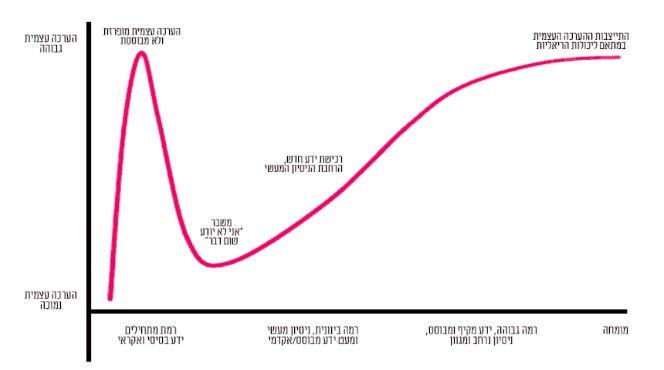
It happens for reasons with names like cognitive bias or metacognition, but between us it’s what we call arrogance — that moment when positive feedback makes us feel important and pushes us to try again. If I’m honest, I fall for it too sometimes; today’s world pushes the “I” outward: “build your brand,” “differentiate yourself.” A whole world of behavior design pushes all of us to be experts. We all have that friend who delivers geopolitical briefings after a few minutes of scrolling “Abu Ali Express.”
The ability to examine information and think critically must be a foundation for a student in the new era. How do you tell reliable information from nonsense? How do you read critically? How do you ask deep questions? And what should you ask the teacher in class today?
So what do we do?
First, we teach our kids about technology. Unless they’ll live in space or an Amish community, critical reading and knowledge reliability are basic tools. Our kids need to understand what artificial intelligence is and that not everything written was written by people. To develop critical thinking they need to understand why people make products (for money); they need knowledge that explains how we consume information and what forces drive markets and the economy. Yes, even at their young age.
For a long time I’ve tried to explain to my daughters that I won’t spend money on mall claw machines — the ones where you put in five shekels and never catch a plastic ball full of unclear goo. “I think it’s a waste of money,” I tell them, but my daughters, quite cleverly, steer the conversation to my other wastes and I get tangled in half-baked answers (“Want to use them? Use your own money”).
Last summer I came prepared; I knew I needed a strong argument. I wanted them to understand a video-game maker’s main consideration. “No, he doesn’t want you happy and joyful,” I said, using a racing game as an example; I told them he’d make sure they finish feeling “more,” not satisfied. I even ran a little simulation: “The moment you’re at the peak of a lap and want to finish it, the game ends. What do you think you’ll want to do — stop playing or keep going?”
For now, that front is quiet.
What else can we do?
Researchers who studied this suggest something fairly refreshing - strengthen the figure of the teacher. They suggest turning the teacher into a kind of judge of information, a role model, explaining how they prepare a lesson, asking critical questions during class, and especially answering “I don’t know” a lot. If the teacher is also a model for being able to err and correct, or for critical thinking, the researchers argue, students will develop the tools needed for 2024.
At home and in class, alongside acquiring information, a student needs tools to verify it. It isn’t enough to repeat again and again the “fact” (?) that screen time is bad for the eyes; it’s also worth checking whether that’s still true for screens made in 2024. Challenge our own assertions and teach kids critical thinking - including about the things we’re really experts in, and maybe especially those.